 Alabama#3004511078
 Alaska#3004494564
 Arizona#3004472643
 Arkansas#3004469941
 California#6020529
 Colorado#971003
 Connecticut#3004469920
 Delaware#3004469932
 District of Columbia#3004469940
 FloridaLaunching soon
 Georgia#247985
 Hawaii#3004511120
 Idaho#3004470780
 Illinois#3004469946
 Indiana#4268451
 Iowa#3004469916
 Kansas#3004469928
 Kentucky#DOI-1487828
 Louisiana#1285886
 Maine#AGN563290
 Maryland#3004469936
 MassachusettsLaunching soon
 Michigan#0164731
 Minnesota#41063462
 Mississippi#15057863
 Missouri#3004523835
 Montana#3004514253
 Nebraska#3004469965
 Nevada#4268470
 New Hampshire#3004511341
 New Jersey#3004469913
 New Mexico#3004522586
 New YorkLaunching soon
 North Carolina#3004469923
 North Dakota#3004469929
 Ohio#1780458
 Oklahoma#3004469963
 Oregon#22330509
 Pennsylvania#1347634
 Rhode Island#3004469960
 South Carolina#3004469915
 South Dakota#22346185
 Tennessee#3004469926
 Texas#3569982
 Utah#1139297
 Vermont#3004469899
 Virginia#168112
 Washington#1387544
 West Virginia#3004470366
 Wisconsin#3004524190
 Wyoming#684053
The Two Bonds for the Job You Just Won.
Send us your contract and the owner's bond form, and our underwriters usually reply within one business day. On a federal job you get no notice to proceed until both Bonds are in.
What this bond covers Federal
Performance and Payment Surety Bond




Construction
The Performance and Payment Bond, explained.
7,904 Bonds, every state.
Search all bondsA reply within one business day.
Signed and ready to file.
What is the Performance and Payment Bond?
Two Bonds an owner asks for before you start a construction job. The Performance Bond promises you carry out the contract. The Payment Bond promises everyone who supplies labor or material on the job gets paid.
Owners ask for the two together, so they are sold here together and priced as a pair. When you buy here, the Bond company sends you the signed Bonds with its power of attorney.
What you promise
- The work: you perform every term of the contract, including extensions, guarantees and authorized changes.
- Payment: you promptly pay everyone who supplies labor or material to you or to your subcontractors on the job.
- Payroll taxes, on federal jobs: the Performance Bond also covers the federal taxes you withhold from your workers' pay on the job.
Finish the job and pay everyone, and neither Bond is ever used.
State, city and private jobs: the owner usually hands you its own form, and your contract or bid documents name it.
The federal forms
On a federal job each Bond goes on its own government form. The General Services Administration's current edition of both is 10/2023, and the Performance Bond form says the previous edition is not usable.
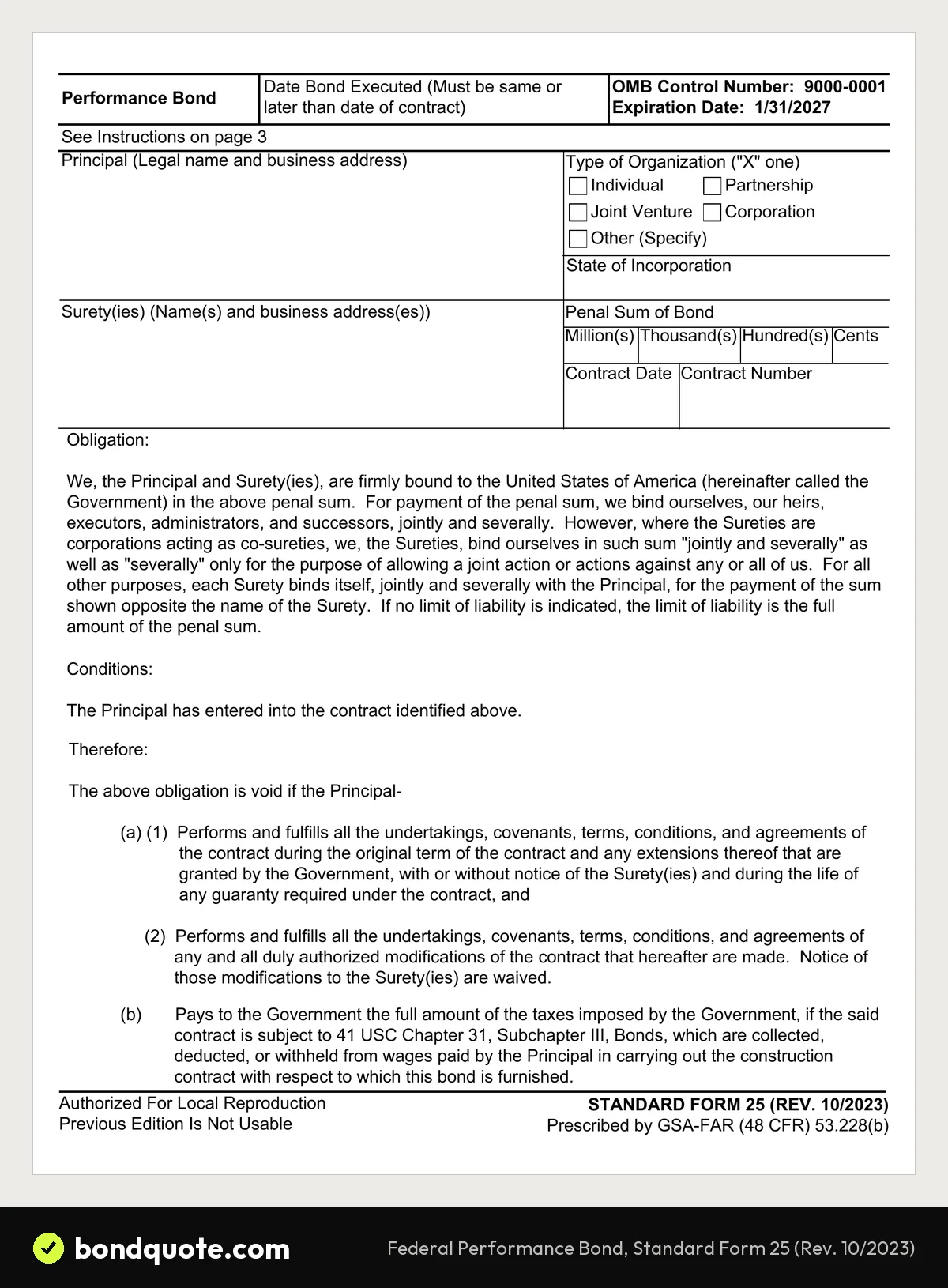
The blank form: you can read the Performance Bond, Standard Form 25 (PDF, Rev. 10/2023) before you buy.
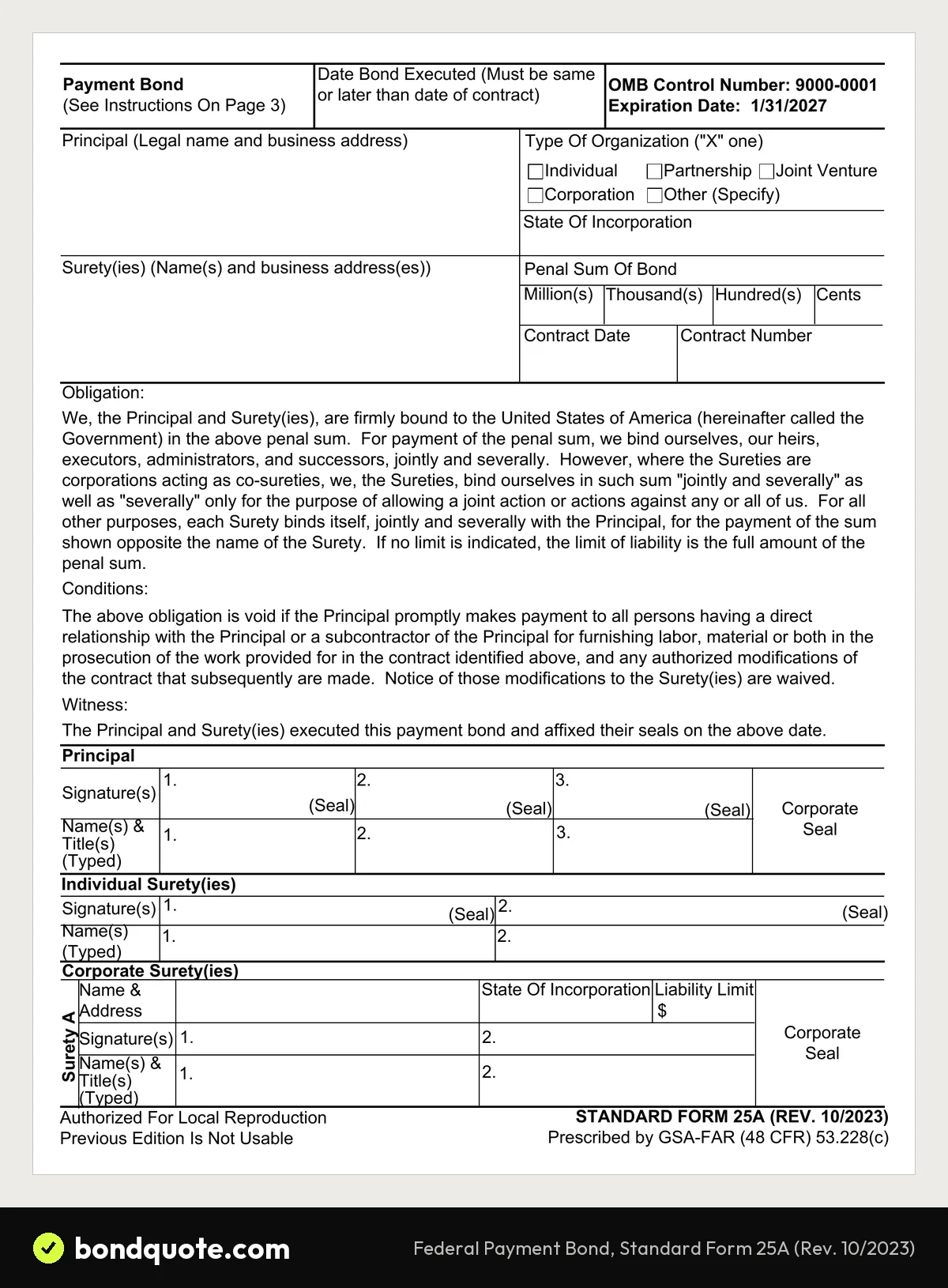
The second form: the Payment Bond, Standard Form 25A (PDF, Rev. 10/2023) goes with it.
Changes to the wording: any change to the federal forms needs the written approval of the GSA Administrator.
How these Bonds work
- You pay the premium in your quote.
- The Bond company stands behind your contract, up to each Bond's amount.
- On a federal job both Bonds are made out to the United States of America.
Sources: U.S. government
gsa.gov: SF25 23b (PDF)gsa.gov: SF25A 23a (PDF)How much does this Bond cost?
Our underwriters set your price for your job, starting at $250.
Our underwriters price both Bonds from your contract and your application, and you get one quote for the pair. On the federal form: the Performance Bond, Standard Form 25, has its own block for the premium, written as a rate per thousand dollars and a total. With SBA backing: when the SBA guarantees your Bonds, it charges its own fee of 0.6 percent of the contract price, refunded if the Bond is canceled or never issued. What it usually costs: Performance and Payment Bonds usually cost from under 0.5 percent to 3 percent of the contract price, and a small or new contractor can usually expect 2 to 3 percent. The price follows the rates Bond companies file with the state insurance department, and it usually moves up or down with the final contract price. When you pay: the premium is usually paid when the Bonds are signed, and contract Bonds usually cannot be canceled.
Do I pay the full Bond amount?
No. On a federal job each Bond equals the contract price, and that is what the Bond company stands behind. What you pay is the premium in your quote.
A $300,000 federal contract means a $300,000 Performance Bond and a $300,000 Payment Bond, and your premium is a small part of that. Our guide to what a Surety Bond costs explains the two numbers.
Who needs this Bond?
Every contractor awarded a federal construction contract over $150,000 needs both Bonds. On a state, city or private job, the owner's bid documents or contract tell you.
Federal jobs
- Contracts over $150,000: a contract to build, alter or repair a federal public building or public work needs both Bonds.
- Contracts over $35,000 up to $150,000: the contracting officer picks two or more kinds of payment protection, such as a Payment Bond, a letter of credit, an escrow agreement or certificates of deposit, and you give one.
- Work in a foreign country: the Bonds can be waived when furnishing them there is impracticable.
The federal contracting rules set the line at $150,000, and the rules' current overhaul keeps the same figures.
State, city and private jobs
These Bonds are not only federal. A state, city or private owner usually hands you its own form, and your bid documents or contract say which Bonds it wants and for how much. Some states and cities have their own page in our list of Performance and Payment Bonds.
Still bidding: the Bond that goes in with your bid is the Bid Bond. Once you win, this is the next Bond you need.
Sources: U.S. government and law.cornell.edu
acquisition.govlaw.cornell.eduHow fast can I get this Bond?
Our underwriters usually reply within one business day. Your quote follows once they have the details they ask for, and your Bonds come by email once you pay.
Plan around your start date: apply as soon as you know you won, because on a federal job you get no notice to proceed until the Bonds are in. What sets the time: how long approval takes depends on the size of the job, the financial review, the Bond's wording and how complete your application is. Tell us your deadline when you apply.
What happens if there's a claim on this Bond?
If the work is not done, the owner claims on the Performance Bond. If someone who supplied labor or material goes unpaid, they claim on the Payment Bond, up to its amount.
The rules below are the federal ones, under the Miller Act. A state, city or private job follows its own law and the wording of its form.
The Performance Bond: on a federal job it protects the Government, so the claim is the Government's. The Bond company looks into a claim before it pays. Depending on the Bond, it may help finish the work, bring in another contractor, or pay what it owes under the Bond.
Who can claim on the Payment Bond
- Anyone who supplied labor or material: they can sue on the Bond once 90 days pass after their last work or delivery without full payment.
- Suppliers to your subcontractor: a supplier or sub-subcontractor who dealt only with your subcontractor must first give you written notice within 90 days of their last work or delivery.
Where and by when
The suit is brought in the name of the United States, in the federal district court where the contract was performed. It must be filed no later than one year after the claimant's last labor or material.
A copy of the Bond: anyone who supplied labor or material and was not paid can get a certified copy of the Payment Bond and the contract from the agency.
Waivers: a waiver of the right to sue on the Payment Bond counts only when it is in writing, signed, and made after the person furnished labor or material.
After a claim: before it issues a Bond, the Bond company usually has you and other indemnitors sign an indemnity agreement, so if it pays a claim, you pay it back. The agreement usually covers every Bond that company writes for you. What is a Surety Bond explains how that works.
Sources: law.cornell.edu and nasbp.org
law.cornell.edu: 3133law.cornell.edu: 3131nasbp.orgHow do I file this Bond?
You deliver both signed Bonds to the owner before you start work. On a federal job you get no notice to proceed, the go-ahead to start, until they are in.
You just won the job, and the work cannot start without the Bonds. When you buy here, the Bond company sends you both signed Bonds with its power of attorney, and you deliver them to the owner.
On a federal job
- Before work starts: you furnish the Bonds before you receive a notice to proceed or are allowed to start work.
- The date on the Bond: each Bond must be dated the same day as the contract or later.
- The Bond company: it must be on the Treasury's list of approved companies, Circular 570, and act within its limit.
- The signatures: whoever signs for the Bond company shows proof of authority, and a corporation adds its corporate seal.
A person as surety: an individual who signs as surety instead of a company must attach an Affidavit of Individual Surety, Standard Form 28.
Sources: U.S. government
acquisition.govgsa.govHow big does this Bond have to be?
On a federal job each Bond is 100 percent of the original contract price. A $300,000 contract means a $300,000 Performance Bond and a $300,000 Payment Bond.
How the federal amount is set
- Price increases: each Bond grows by 100 percent of any increase in the contract price. Tell us about a change order or an extension, because the Bond company may need to approve it and more premium may apply.
- A smaller Performance Bond: the contracting officer may find a smaller amount adequate.
- The Payment Bond: it stays at the full contract price unless the officer finds in writing that this is impractical, and it is never smaller than the Performance Bond.
- Options: the original contract price is the award price, so options not exercised at award do not count.
Sources: U.S. government and law.cornell.edu
acquisition.govlaw.cornell.eduCan a small business get this Bond?
Yes. The SBA backs these Bonds for small businesses that might not meet a Bond company's usual criteria, on contracts up to $9 million, or $14 million on federal work.
What the SBA asks
- Size: your business must be small under the SBA's size standards.
- The contract: the job must be up to $9 million, or $14 million on a federal contract.
- The Bond company's review: you still have to meet its credit, capacity and character requirements.
The SBA's fee: the SBA charges 0.6 percent of the contract price on a Performance and Payment Bond it backs, refunded if the Bond is canceled or never issued. A Bid Bond guarantee carries no fee.
Contract Bonds only: the SBA guarantees Bid, Performance and Payment Bonds, never commercial Bonds.
Source: U.S. government
sba.govWhat do I need to apply for this Bond?
Bond companies usually ask for three years of year-end financial statements, a current interim statement and your bank line of credit. Each Bond is underwritten on its own.
What a Bond company usually asks for
- Financial statements: three years of year-end statements and a current interim one.
- Your bank: your line-of-credit agreements.
- The owners: their personal financial statements.
- Your work: a work-in-progress report and resumes of your key people.
What to have ready about the job
Have the owner's name, the contract amount, the scope of work, the location and the schedule. Add the bond form the owner requires, the Bond amount and your deadline.
About your business: the application asks for your legal business name, who owns it, your address, your past projects, and your current jobs and backlog.
Source: nasbp.org
nasbp.orgFederal Law CheckVerified November 25, 2026.SF 25 reissued, edition 10/2023Latest
The federal Performance Bond form. The previous edition is not usable.Source: U.S. government
SF 25 reissued, edition 10/2023Latest
The federal Performance Bond form. The previous edition is not usable.Source: U.S. governmentSF 25A reissued, edition 10/2023
The federal Payment Bond form. The previous edition is not usable.
Source: U.S. government
gsa.govLower threshold raised to $35,000
The smallest federal construction contract that needs a payment protection rose from over $30,000 to over $35,000.
Source: U.S. government
federalregister.govThreshold raised to $150,000
On federal contracts the Bonds were now needed only over $150,000 instead of over $100,000.
Source: U.S. government
federalregister.govLower threshold raised to $30,000
The smallest federal construction contract that needs a payment protection rose from over $25,000 to over $30,000.
Source: U.S. government
federalregister.govPayment Bond raised to full price
The payment Bond rose from half the contract price or less to the total amount payable under the contract.
Source: U.S. government
govinfo.govThreshold raised to $100,000
The Miller Act Bonds were now needed only on federal contracts over $100,000 instead of over $25,000.
Source: U.S. government
govinfo.govOther protection under $100,000
Contracts over $25,000 up to $100,000 got other payment protections in place of the Bonds.
Source: U.S. government
govinfo.govThreshold raised to $25,000
The Miller Act Bonds were now needed on federal contracts over $25,000 instead of over $2,000.
Source: U.S. government
govinfo.govMiller Act: two Bonds
One Bond became two, a performance Bond and a payment Bond, on federal construction contracts over $2,000. In effect 60 days after this approval date.
Source: U.S. government
govinfo.govBond began
Congress first made a contractor on a federal public building or public work give a Bond that also promised to pay those who supplied labor and materials.
Source: U.S. government
govinfo.govSource: U.S. government
gsa.gov Federal
Performance and Payment Surety Bond
Construction
There are 22 more federal Construction Bonds.
FederalConstructionThis bondPerformance and Payment BondNationwideFederalConstructionThis bondPerformance and Payment BondNationwideSTARTS AT$250/year$20.84/mo paid annuallyRate: As low as 3%Custom QuoteFederalConstructionContractor Prequalification (Performance Plus) BondNationwideFederalConstructionContractor Prequalification (Performance Plus) BondNationwidePRICED FOR YOUCustomCustom QuoteFederalConstructionFirst Solar, Inc Solar Photovoltaic Payment BondNationwideFederalConstructionFirst Solar, Inc Solar Photovoltaic Payment BondNationwideSTARTS AT$250/year$20.84/mo paid annuallyRate: As low as 5%Custom QuoteFederalConstructionBid BondNationwideFederalConstructionBid BondNationwidePRICED FOR YOUCustomCustom QuoteFederalConstructionBureau of Land Management (BLM) Right of Way Permit BondNationwideFederalConstructionBureau of Land Management (BLM) Right of Way Permit BondNationwideSTARTS AT$100/year$8.34/mo paid annuallyRate: As low as 1%Instant Quote5 of 23 Bonds
Construction