 Alabama#3004511078
 Alaska#3004494564
 Arizona#3004472643
 Arkansas#3004469941
 California#6020529
 Colorado#971003
 Connecticut#3004469920
 Delaware#3004469932
 District of Columbia#3004469940
 FloridaLaunching soon
 Georgia#247985
 Hawaii#3004511120
 Idaho#3004470780
 Illinois#3004469946
 Indiana#4268451
 Iowa#3004469916
 Kansas#3004469928
 Kentucky#DOI-1487828
 Louisiana#1285886
 Maine#AGN563290
 Maryland#3004469936
 MassachusettsLaunching soon
 Michigan#0164731
 Minnesota#41063462
 Mississippi#15057863
 Missouri#3004523835
 Montana#3004514253
 Nebraska#3004469965
 Nevada#4268470
 New Hampshire#3004511341
 New Jersey#3004469913
 New Mexico#3004522586
 New YorkLaunching soon
 North Carolina#3004469923
 North Dakota#3004469929
 Ohio#1780458
 Oklahoma#3004469963
 Oregon#22330509
 Pennsylvania#1347634
 Rhode Island#3004469960
 South Carolina#3004469915
 South Dakota#22346185
 Tennessee#3004469926
 Texas#3569982
 Utah#1139297
 Vermont#3004469899
 Virginia#168112
 Washington#1387544
 West Virginia#3004470366
 Wisconsin#3004524190
 Wyoming#684053
The Customs Bond That Gets Your Imports Released.
Send us the details and you'll have your quote within 48 hours. You need an active ACE account before any Bond is submitted, and CBP typically takes one to two weeks to process a continuous Bond.
What this bond covers Federal
Customs Basic Importation and Entry Surety Bond





Freight
The Customs Basic Importation and Entry Bond, explained.
7,904 Bonds, every state.
Search all bondsYour quote within 48 hours.
Signed and ready to file.
What is the Customs Basic Importation and Entry Bond?
The Customs Bond promises CBP that you pay your duties, taxes and fees on imports and follow the import rules. CBP is the party the Bond protects.
CBP's form is the Customs Bond, CBP Form 301, and this Bond is its Activity Code 1, for an importer or broker. Each Form 301 is either a single transaction Bond or a continuous Bond, never both.
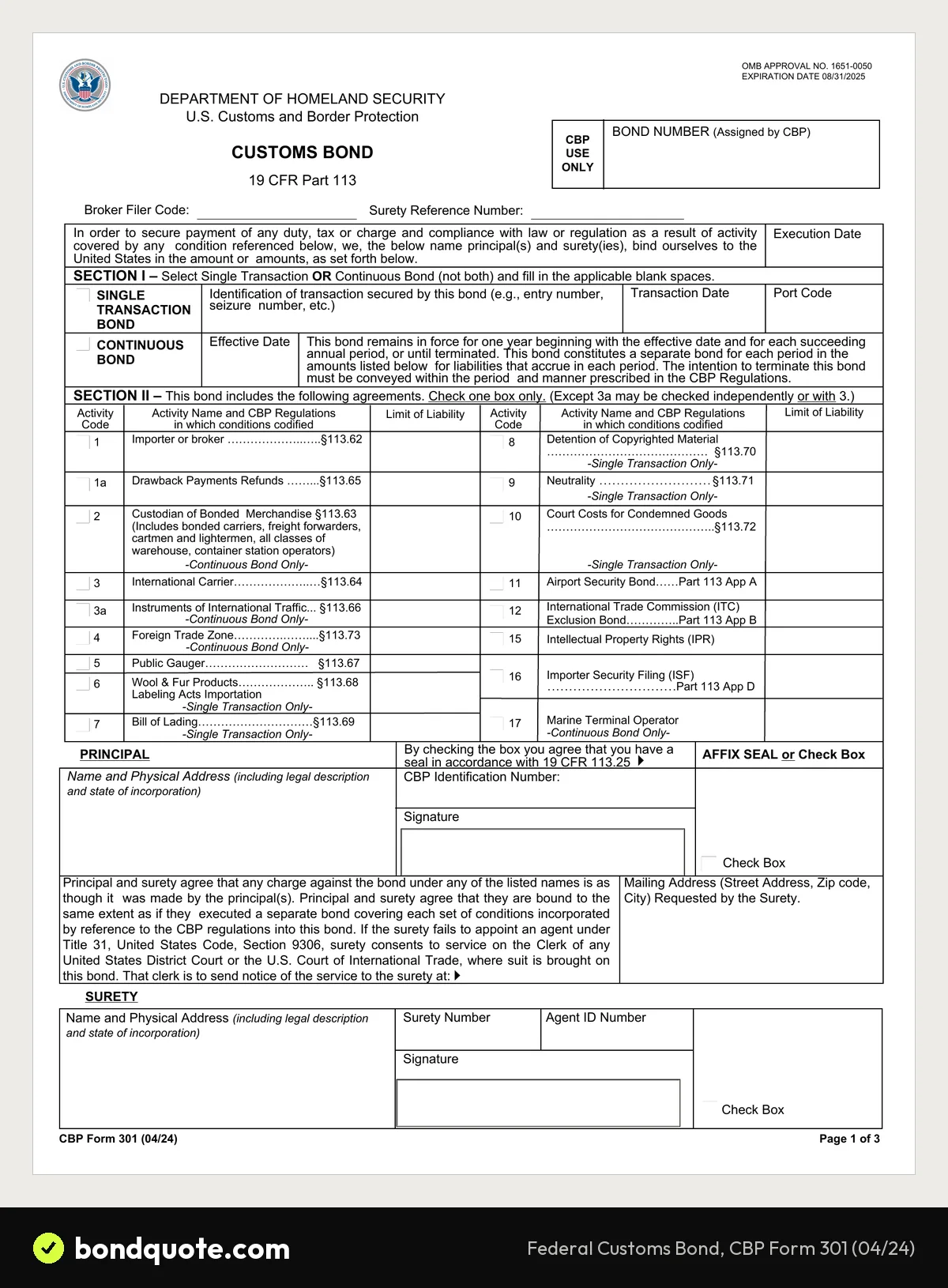
The blank form: you can read CBP's Customs Bond, CBP Form 301 (PDF, 04/24) before you buy. CBP says the form is still valid although its printed OMB date has passed.
What you promise
- Pay what is due: you deposit duties, taxes and charges at release and pay any more found due later, and you and the Bond company are each liable for the whole amount.
- Finish the entry: you complete the entry, produce the documents and redeliver goods when CBP demands it.
- Examination and admission: you make goods available for examination and fix admission problems.
- Cargo filing: you meet CBP's electronic and advance cargo filing rules.
The Bond company: it must be listed in Treasury Circular 570, named exactly as it appears there, and no Bond may exceed its listed limit unless reinsured. When you buy here, our underwriters write the Bond for you.
Other CBP Bonds, for other activity codes, are on our Customs Bonds page.
How this Bond works
- You pay the premium in your quote.
- The Bond company stands behind the Bond amount.
- CBP, the party the Bond protects, collects from it if you do not pay or follow the import rules.
How much does this Bond cost?
Our underwriters set your price from your Bond amount, starting at $100.
CBP's own words: CBP says a single entry premium is usually a small percentage of the Bond amount.
Do I pay the full Bond amount?
No. The Bond amount is what CBP can collect from the Bond company. What you pay is the premium in your quote.
Our guide to what a Surety Bond costs explains the two numbers.
Who needs this Bond?
Almost every formal import entry needs this Bond, whether you are the importer or a broker. CBP does not release goods at entry without a single transaction or continuous Bond on file.
Two kinds
- Continuous Bond: it covers a year of your entries and renews each year until terminated, and each year is a separate Bond for that year.
- Single transaction Bond: it covers one entry, named by its entry number, date and port code.
Without a continuous Bond: every bonded entry needs its own single transaction Bond, and you may hold only one continuous Bond per activity.
Importer Security Filing: an ISF importer must hold a Bond, and this Bond satisfies that.
Who may not need one
- Shipments worth $2,500 or less: they may use informal entry, with exceptions.
- A waiver at the port: the port director may waive the surety for goods worth $2,500 or less when duties are paid before release and your record is clean. Quota goods and goods hard to appraise do not qualify.
Changes coming: CBP has proposed that informal entry filers (types 11 and 13) also get this Bond, with comments due December 7, 2026; it is not final. The de minimis exemption is suspended and ends by law on July 1, 2027.
Sources: U.S. government
ecfr.govhelp.cbp.govHow fast can I get this Bond?
Your quote comes by email within 48 hours, and your Bond follows once you pay.
Then CBP: CBP typically takes one to two weeks to process a continuous Bond and link it to your importer number.
What happens if there's a claim on this Bond?
If you do not pay what is due or break a Bond condition, CBP can collect from you or the Bond company, up to the Bond amount. The rules set the default charges, called liquidated damages.
What a default costs
- Goods involved: liquidated damages equal the goods' value, or three times the value for restricted or prohibited goods or alcohol.
- No goods involved: $1,000 for each default.
- Unpaid estimated duties: twice the unpaid amount or $1,000, whichever is more.
- Advance cargo filing: $5,000 for each violation.
When the Bond runs out: the Bond is exhausted when the Bond company has paid its full amount, per year on a continuous Bond. Your own payments do not use it up.
Foreign importers: CBP says the basic Bond sometimes runs out before covering what a foreign importer owes, and new rules for foreign importers of record take effect January 5, 2027.
How do I file this Bond?
You apply with a Treasury-listed Bond company or a customs broker acting for one, and the Bond goes to CBP's bond team, not to a port. Before any Bond is submitted, you need an active ACE account, CBP's electronic trade system.
Before you apply
- An ACE account first: you set it up with CBP Form 5106.
- Your importer number: you give your CBP identification number, and an IRS EIN carries its two-digit suffix, 11 digits in all.
- Your details: you give your full legal name and business type, a physical address (not a P.O. Box), your state of incorporation and any trade names that will use the Bond.
- Your imports: for a continuous Bond, you state the kind of goods and the prior calendar year's duties and taxes, or an estimate.
The paperwork: you fill out the application, sign a power of attorney, and may be asked for financial statements.
Dates
- Filing ahead: a continuous Bond may be filed up to 60 days before it takes effect.
- Signing: the Bond is signed on or before its effective date, or the transaction date for a single entry.
How it reaches CBP: approved Bond companies send Bonds to ACE electronically through eBond, and others email them to CBP. CBP has proposed making electronic filing the rule for most Bonds; that is not final.
Partners: on a continuous Bond, a limited partnership attaches its partnership agreement and a general partnership lists its partners. More than two co-principals need Form 301A, and a co-principal cannot be added later by rider.
When you buy here
Our underwriters are in contact with you within 48 hours of your application. Any credit check is a soft one, and it does not affect your credit score.
Once you are approved, you get an email to pay, and the Bond is issued when it is paid.
Sources: U.S. government
help.cbp.govcbp.govWhat happens if this Bond stops?
A terminated Bond takes no new entries, so you need a new Bond before your next import. The Bond company can stop future liability with 30 days' notice to CBP and to you.
Ending it yourself: you send a written request to CBP's Revenue Division. The Bond ends on the date you ask if that is at least 10 business days after CBP gets the request, and otherwise on the 10th business day.
Old obligations stay: the Bond company cannot escape obligations already incurred.
No originals back: only the Commissioner can cancel a Bond, and CBP never returns the original.
The yearly premium: on a continuous Bond you get an email 60 days and 30 days before the premium is due again.
How much should my Bond be?
A continuous Bond is $50,000 or 10 percent of the duties, taxes and fees from the prior 12 months, whichever is greater. A single transaction Bond is generally at least the entered value plus duties, taxes and fees.
Continuous Bonds
- The steps: amounts go up in $10,000 steps to $100,000, then in $100,000 steps.
- No imports last year: the amount comes from the next 12 months' estimated duties, taxes and fees, and it is never under $50,000.
- Unpaid bills: 10 percent of delinquent bills under 210 days or under protest is added, and 100 percent of bills over 210 days or with a denied protest.
- Left out of the count: informal entries under $2,500, Section 321 de minimis entries, warehouse withdrawals and drawback.
A $50,000 continuous Bond: that is the minimum, and it matches 10 percent of $500,000 in yearly duties, taxes and fees.
Single transaction exceptions
- Duty-free goods: the Bond is 10 percent of their value.
- Restricted goods: the Bond is three times their value, at least $100.
- Temporary importation under Bond: the Bond is twice the estimated duties.
If CBP finds it too small: you have 15 days from CBP's notice to fix it, and CBP may ask for cash or a single transaction Bond meanwhile. A single transaction Bond can be raised only in the 10 days between entry and entry summary.
The floor: no CBP Bond may be under $100, and amounts are whole dollars.
What CBP weighs: CBP judges whether a Bond is big enough from your payment history, compliance record, the value and nature of your goods, CBP's supervision, any liquidated damages history and your application.
Can you import without this Bond by putting up cash?
Yes. Cash or U.S. obligations can stand in for a Bond company, for no more than one year, with a Form 301 filed with it.Federal Law CheckVerified November 25, 2026.CBP Form 301 reissued, edition 04/24Latest
CBP's Bond form carries this edition date.Source: U.S. government
CBP Form 301 reissued, edition 04/24Latest
CBP's Bond form carries this edition date.Source: U.S. governmentContinuous Bonds centralized
Continuous Bonds were now processed centrally at CBP's Revenue Division, and Bonds could be scanned and sent to CBP by email or fax.
Source: U.S. government
govinfo.govElectronic bonds test began
Approved sureties could now send Bonds to CBP electronically in ACE, through the voluntary eBond test.
Source: U.S. government
cbp.govImporter Security Filing added
The Bond took on a new condition: the principal must meet the Importer Security Filing rules, with $5,000 in liquidated damages for each violation.
Source: U.S. government
federalregister.govBond began
Customs' bond rules, 19 CFR part 113, were published, with the basic importation and entry Bond conditions in section 113.62.
Source: U.S. government
ecfr.govSource: U.S. government
cbp.gov Federal
Customs Basic Importation and Entry Surety Bond
Freight
There are 8 more federal Freight Bonds.
FederalFreightThis bondCustoms Basic Importation and Entry BondNationwideFederalFreightThis bondCustoms Basic Importation and Entry BondNationwideSTARTS AT$100/year$8.34/mo paid annuallyRate: As low as 2%Custom QuoteFederalFreightAirport Customs Security Area Bond ($25,000 to $100,000)NationwideFederalFreightAirport Customs Security Area Bond ($25,000 to $100,000)NationwideSTARTS AT$100/year$8.34/mo paid annuallyRate: As low as 1%Custom QuoteFederalFreightFreight Broker and Freight Forwarder Bond ($75,000)NationwideFederalFreightFreight Broker and Freight Forwarder Bond ($75,000)NationwidePRICED FOR YOUCustomCustom QuoteFederalFreightOcean Transportation Intermediary (OTI) (FMC-48) Corporation BondNationwideFederalFreightOcean Transportation Intermediary (OTI) (FMC-48) Corporation BondNationwideSTARTS AT$100/year$8.34/mo paid annuallyRate: As low as 4%Custom QuoteFederalFreightOcean Transportation Intermediary (OTI) (FMC-48) Sole Prop or Partnership BondNationwideFederalFreightOcean Transportation Intermediary (OTI) (FMC-48) Sole Prop or Partnership BondNationwideSTARTS AT$100/year$8.34/mo paid annuallyRate: As low as 4%Custom Quote5 of 9 Bonds